Key Takeaways
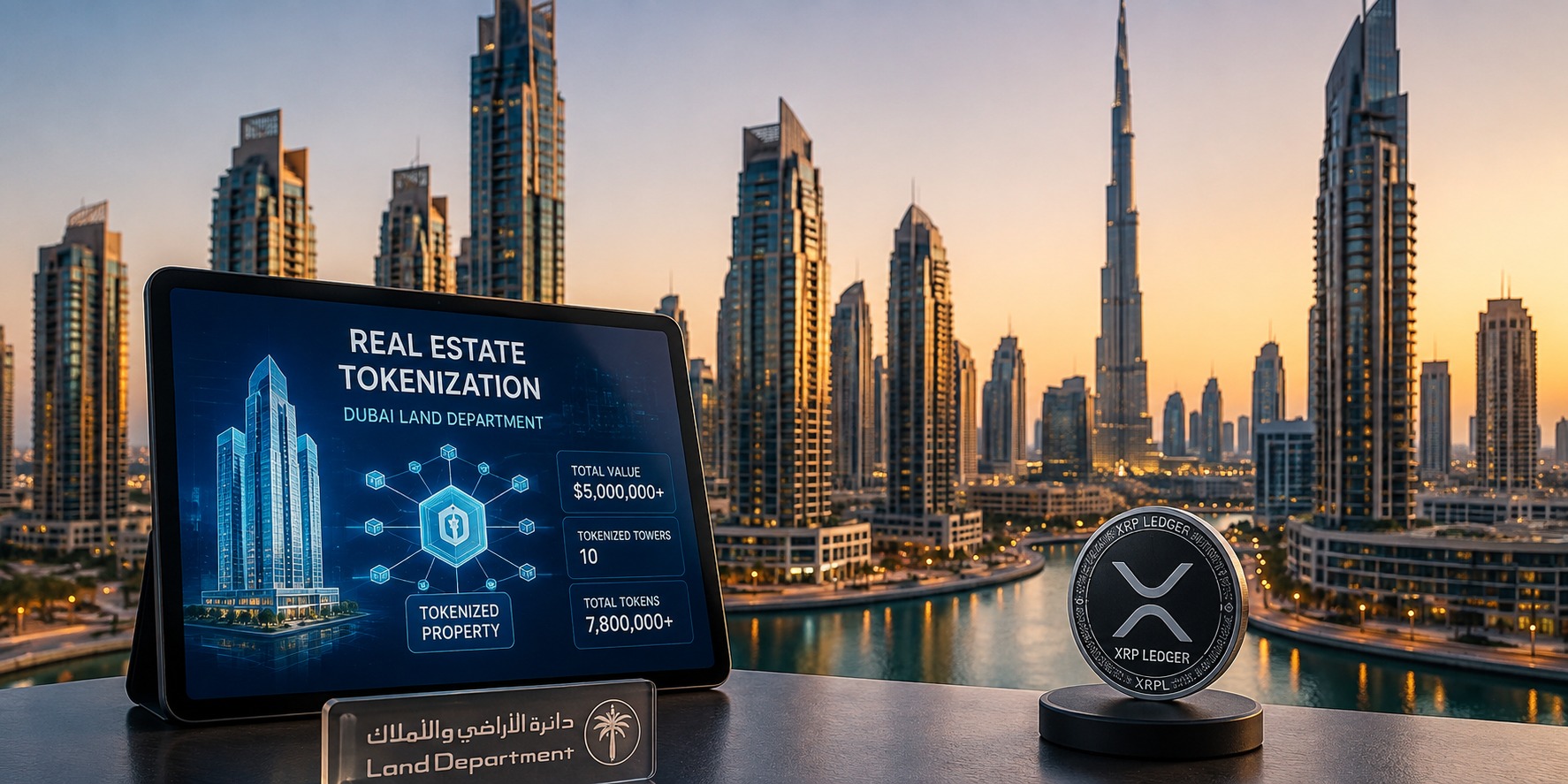
- Dubai is taking another major step toward bringing real estate investment onto blockchain technology, with a government-backed pilot that has tokenized ten physical property towers into approximately 7.8 million digital tokens.
- The minimum investment starts from AED 2,000, or around $540.
- The emirate aims to tokenize around 7% of its real estate market by 2033.
Dubai is taking another major step toward bringing real estate investment onto blockchain technology, with a government-backed pilot that has tokenized ten physical property towers into approximately 7.8 million digital tokens.
The tokens are being introduced through regulated platforms and can be traded on the secondary market, giving investors the ability to buy fractional ownership in Dubai properties rather than purchasing an entire unit. The minimum investment starts from AED 2,000, or around $540.
Transactions are processed through the XRP Ledger (XRPL), where settlement can take only a few seconds. Ripple Custody is being used to provide institutional-level custody and security for the digital assets involved in the project.
Dubai Land Department Expands Property Tokenization
The Dubai Land Department (DLD), the government authority responsible for registering and regulating property ownership in Dubai, selected the XRP Ledger as part of the infrastructure supporting its real estate tokenization initiative.
During the first phase of the project, title-deed tokens representing more than $5 million worth of real estate were successfully issued.
The project has now moved into its second phase, which introduces controlled secondary-market trading. This means eligible investors can purchase fractional shares in tokenized properties and later sell those holdings through approved platforms.
One of the most important parts of the system is the connection between blockchain records and Dubai’s official property registry. When ownership of a tokenized asset changes, the transaction is synchronized with the relevant land records, helping ensure that digital ownership information remains aligned with the official registry.
Dubai has much larger ambitions for the sector.
The emirate aims to tokenize around 7% of its real estate market by 2033. The expected value of the tokenized property market could reach approximately AED 60 billion, equivalent to around $16 billion.
Reaching that target would require the project to expand well beyond the current ten properties. More title deeds would need to be brought onto the system, additional regulated investment and trading platforms would be required, and participation from both individual and institutional investors would need to increase.
| Phase | Tokenized Properties | Property Value | Trading Access |
|---|---|---|---|
| Phase One | 10 towers | $5 million | Token issuance |
| Phase Two | 10 towers | $5 million+ | Secondary trading |
| 2033 Target | Around 7% of Dubai market | $16 billion | Wider regulated market |
Lower investment requirements could become one of the main attractions of property tokenization.
Traditionally, investing directly in Dubai property requires significant capital. Fractional ownership allows investors to gain exposure to real estate with much smaller amounts.
Starting from AED 2,000 could potentially open the market to a much wider group of investors, including people who may not have been able to purchase a complete property.
A regulated secondary market could also make it easier for investors to enter and exit investments without having to complete the traditional process involved in selling an entire property.
XRPL Supports Dubai’s Digital Real Estate Infrastructure
The XRP Ledger has been selected for the project partly because of its ability to process transactions quickly and at relatively low cost, making it suitable for systems that require large numbers of secure digital transfers.
Digital infrastructure company Ctrl Alt is responsible for parts of the technical process, including the tokenization and management of property title information on-chain.
Ripple Custody provides custody infrastructure designed to protect the digital assets used within the system.
The important difference between this project and many cryptocurrency-based investments is that the tokens are connected to physical real estate and official property records.
Instead of representing a purely digital asset, each token represents an interest linked to an underlying property.
The assets are being structured within Dubai’s regulated digital-asset framework, creating a connection between blockchain-based ownership and the emirate’s existing property registration system.
This combination could allow Dubai to gain some of the efficiency offered by blockchain technology while maintaining the legal protections and ownership records required in a regulated property market.
Another major advantage is transaction speed.
Traditional property transfers can involve several administrative steps and may take considerably longer to complete. Blockchain-based transactions can technically settle within seconds.
Under the tokenization model, changes can be recorded digitally while remaining connected to the official property registry.
This dual system is designed to provide the efficiency of blockchain transactions without separating digital ownership from the legal records maintained by the Dubai Land Department.
The involvement of Dubai’s official land authority is particularly important because real estate tokenization requires more than simply creating a digital token.
For the model to work at scale, investors need clarity about ownership rights, regulation, custody, property records and the ability to trade their interests legally.
The current pilot provides an early example of how these different parts of the system can work together, from title registration and token issuance to custody and secondary-market transactions.
If the model expands successfully, the number and value of tokenized properties could increase substantially over the coming years.
Dubai’s target of building a tokenized real estate market worth around $16 billion by 2033 would make blockchain-based fractional property ownership a meaningful part of the emirate’s wider real estate sector rather than simply a small technology experiment.
What Is the XRP Ledger?
The XRP Ledger, commonly known as XRPL, is a public blockchain designed for fast and low-cost transactions. In addition to supporting digital currencies, the network can be used to represent and transfer tokenized real-world assets, including financial instruments and property-related assets.
For Dubai’s real estate market, tokenization could ultimately make property investment more accessible by allowing investors to purchase smaller ownership interests, trade them through regulated platforms and complete transactions more quickly.
The bigger development, however, is the connection between blockchain technology and Dubai’s official land registration system.
Rather than creating a separate digital property market, the initiative is designed to bring blockchain-based ownership into an existing regulated real estate framework.
If Dubai reaches its 2033 target, tokenized property could develop from today’s ten-building pilot into an AED 60 billion segment of the city’s real estate market.
Sources