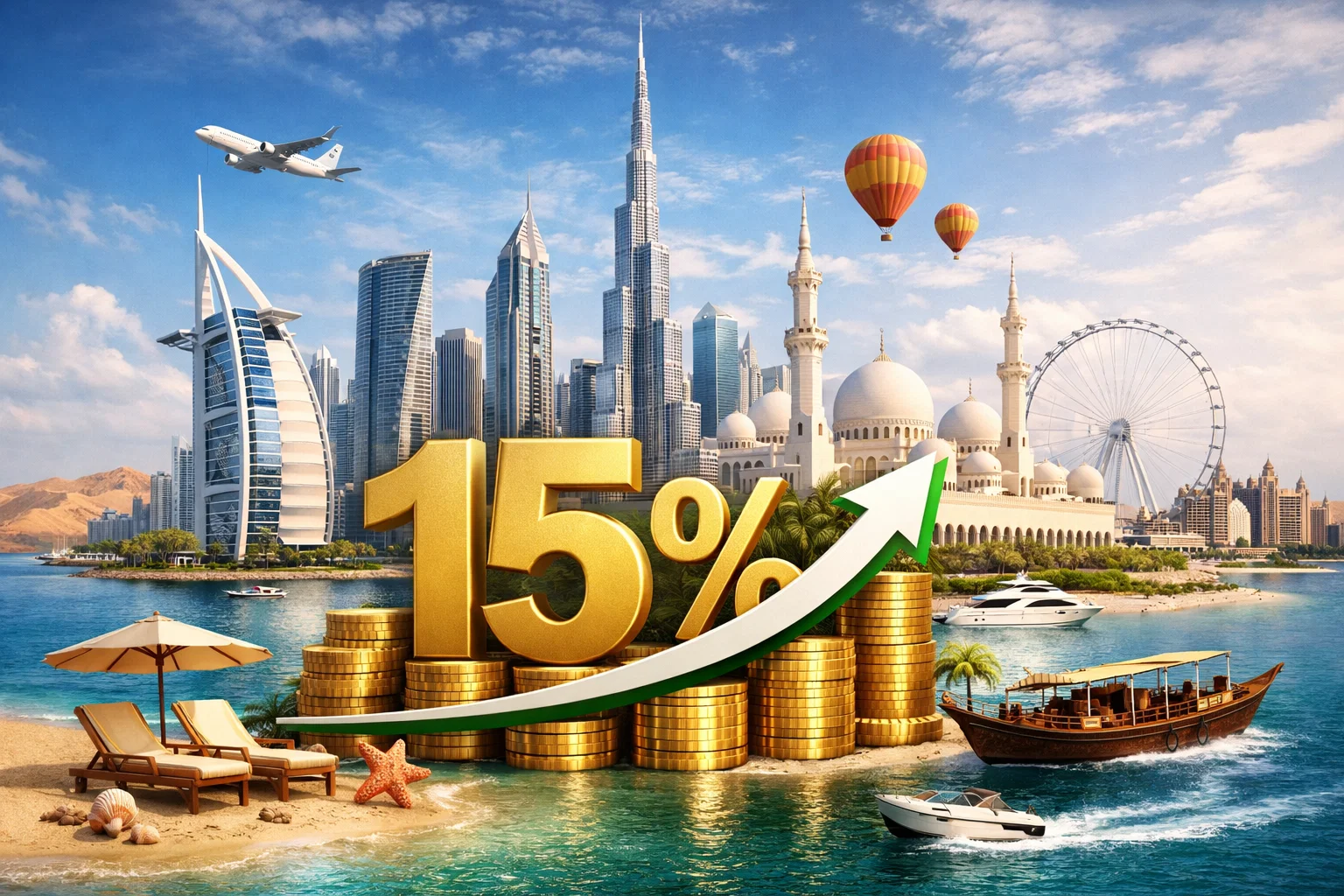
In a clear indication of the structural transformation taking place in the UAE economy, the Minister of Economy and Tourism, Abdullah bin Touq Al Marri, revealed that the contribution of the tourism sector to the UAE’s GDP reached approximately AED 291 billion—around 15% of total GDP—according to performance estimates for 2025, as stated in remarks published at the beginning of 2026.
This figure does not merely reflect seasonal tourist spending; rather, it confirms that tourism has become one of the main pillars of the non-oil economy and a key driver of growth and investment.
What does AED 291 billion mean?
It is important to understand the significance of this number accurately. The AED 291 billion represents the total value added of the tourism sector to the economy, including:
- Hotels and hospitality
- Transport and travel
- Entertainment and events
- Restaurants and tourism-related retail
In other words, it reflects tourism’s contribution to GDP, not just direct tourist spending. When compared to 2021—when tourism’s contribution did not exceed 6% of GDP—it becomes clear that the sector achieved cumulative growth of nearly 216% in just four years, an exceptional rate by the standards of advanced economies.
Although the statements were issued at the beginning of 2026, they refer to the actual or near-final performance of 2025. This comes within a broader context in which non-oil sectors now contribute around 77.5% of the overall economy.
This confirms that tourism did not grow in isolation, but rather as an integral part of reshaping the UAE’s growth model away from oil dependence.
Why did tourism grow so rapidly?
This surge was not random; it was the result of carefully planned government strategies and massive investments. Most notably, the UAE launched the National Tourism Strategy 2031 and the National Tourism Charter, creating an attractive regulatory environment, wide investment incentives, and direct support for tourism companies and projects.
As a result, tourism investments reached AED 35.2 billion in 2025, while the number of hotel rooms rose to more than 216,000.
The UAE also witnessed qualitative expansion in tourism and entertainment projects, alongside hosting global events and major exhibitions. The hotel sector alone recorded revenues of AED 13.5 billion in the first quarter of 2025, with continuous growth in guest numbers—reflecting strong and sustainable demand.
In addition, the country adopted smart international marketing campaigns, eased visa procedures, targeted emerging markets, and advanced digital transformation in tourism services. This contributed to raising tourism spending to AED 228.5 billion, with annual growth of 5.2%.
Deeper economic and investment implications
Tourism reaching a 15% share of GDP sends several important signals:
- Tourism has become a strategic sector, not a complementary one
- Demand for hotel real estate, retail, and entertainment will continue to rise
- The investment environment is more stable and diversified
- Dependence on oil has declined in favor of sectors with continuous cash flows
For investors, this transformation opens broad opportunities in tourism-linked assets, especially in an economic cycle where global demand is increasing for safe and stable destinations.
What the UAE tourism sector achieved between 2021 and 2025 is not normal growth—it is a deliberate economic transformation. When tourism’s contribution rises from 6% to 15% in just four years, it represents a successful model of economic diversification that has made tourism a pillar of growth, a source of stability, and a magnet for long-term investment.
In this sense, tourism in the UAE is no longer merely a cultural showcase; it has become a beating heart in the equation of the national economy.