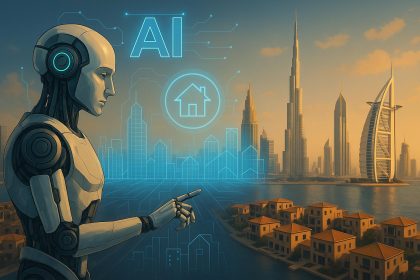
In 2025, Artificial Intelligence (AI) is no longer just an innovative technology that impresses at conferences or an experimental tool in research labs; it has become the main driver and hidden backbone powering the wave of digital transformation across the globe. We have moved from discussing AI’s potential to relying on it in strategic decision-making, achieving efficiency, and reshaping business models.
In previous years, AI played the role of an assistant — processing data, providing recommendations, or speeding up certain operations. Today, it has taken on the role of a leader in digital transformation. Machine Learning and Deep Learning algorithms are now capable of accurately predicting market trends, dynamically managing supply chains, and personalizing digital experiences down to the individual level.
The UAE Model: Global Leadership in AI Implementation
The United Arab Emirates stands as a global example of strategic investment in AI, being the first country in the world to establish a dedicated Ministry of Artificial Intelligence in 2017, spearheading a comprehensive national vision in this field.
By 2025, this vision has yielded tangible results:
- Healthcare: AI-powered diagnostic systems have been deployed in both public and private hospitals, contributing to early disease detection and faster treatment.
- Real Estate: AI-driven property market analysis platforms provide investors with real-time reports on prices, demand, and future trends, boosting market transparency.
- Industry: Smart factories equipped with robotics and predictive maintenance systems reduce breakdowns and increase productivity.
- Government: “Smart Government” and “Proactive Services” initiatives offer residents and citizens government services completed within minutes, with systems able to anticipate needs before requests are made.
- Education: This year, the Ministry of Education introduced AI as a subject in school curricula, preparing a generation capable of innovating and building future technologies rather than merely using them.
Deep Integration with Digital Infrastructure
AI is no longer seen as a standalone solution; it is embedded within the digital infrastructure of organizations. Big Data and the Internet of Things (IoT) now feed intelligent systems with continuous streams of real-time information, enabling more accurate and faster decision-making.
With the growing reliance on AI, the need for strong governance systems has emerged to ensure transparency, fairness, and privacy protection — something the UAE has addressed through advanced regulatory frameworks that balance innovation and security.
Economic and Social Impact
In 2025, AI’s impact goes far beyond accelerating operations or improving efficiency; it has triggered fundamental transformations in both economic and social structures on local and global scales.
- New Professions: High-demand roles have emerged, such as AI model engineers, algorithm trainers, big data analysts, and developers of AI solutions tailored to various sectors.
- Career Shifts: Workers in traditional fields, like customer service, have moved into supervisory roles over automated systems or into creative problem-solving positions that are difficult to fully automate.
- Job Displacement: Routine, repetitive jobs — such as data entry and basic technical support — have been entirely replaced by intelligent systems that operate 24/7.
Companies adopting AI have seen significant boosts in productivity while lowering operational costs. In the UAE, for example, smart traffic management systems have reduced congestion and improved transportation flow, cutting time waste and increasing economic efficiency.
In real estate, AI systems provide instant market analysis, enabling investors to make quick, well-informed decisions — resulting in larger investments in shorter timeframes.
In healthcare, AI-powered early diagnosis platforms have helped reduce complication rates and improve treatment success.
In public services, the UAE’s intelligent response systems can now deliver proactive services — such as renewing documents before expiry or suggesting services based on a citizen’s or resident’s data.
AI has also opened new opportunities for startups and entrepreneurs, giving individuals access to analytical and planning tools that were once exclusive to large corporations.
By 2025, digital transformation has become synonymous with artificial intelligence. Leading organizations worldwide — with the UAE at the forefront — no longer see AI as an optional addition but as a strategic necessity. Countries and companies that deeply integrate AI into their structures will lead the economy of the future, just as the UAE is doing today through its ambitious vision and bold initiatives.