Since the escalation of regional tensions and the outbreak of war involving Iran, a key question has emerged among investors: could these geopolitical developments impact Dubai’s economy or its real estate market?
A realistic reading of the data suggests that Dubai’s property market has not entered a phase of weakness. Instead, it has shifted from a period of rapid momentum to a more mature phase characterized by caution and selectivity. This behavior is typical for any developed market during periods of geopolitical uncertainty.
Most importantly, the market’s core fundamentals remain exceptionally strong, sending a reassuring signal to both local and international investors.
A Strong Market Before the Conflict
Before the recent escalation, Dubai’s real estate market was experiencing one of the strongest cycles in its modern history.
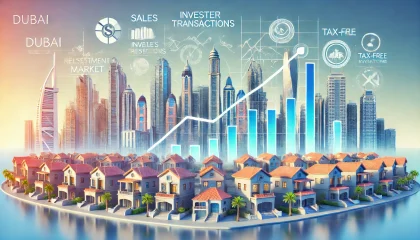
During 2025, the sector recorded record-breaking levels in both transaction volume and sales value. Real estate sales reached approximately AED 495.9 billion during the first nine months of the year, representing an increase of about 32% compared with the same period in 2024.
Other estimates indicate that total property sales in Dubai during 2025 reached around $187 billion across more than 215,000 transactions, driven by strong demand from international investors and significant growth in the luxury property segment.
This momentum continued into 2026. Data showed that January alone recorded a major surge in residential transaction values, reaching approximately AED 55.18 billion, a year-on-year increase of nearly 44%. Off-plan projects accounted for roughly 71% of activity, clearly reflecting investor confidence in the long-term outlook of the market.
The Impact of the War: Caution, Not Decline
With the escalation of military tensions in the region, some behavioral shifts have emerged among investors. However, these changes reflect increased caution rather than market weakness.
The primary observation in the market today is a delay in certain purchase decisions or a temporary reassessment by some investors, particularly those who prefer to wait until the geopolitical situation becomes clearer. Brokers have also reported a rise in requests to postpone transactions or renegotiate certain deals.
However, there are no signs of widespread selling or sharp price declines.
Property prices remain largely stable, and transactions continue—especially in well-located projects developed by reputable developers.
In other words, what the market is experiencing today is a natural slowdown in decision-making rather than a structural change in market fundamentals.
Why Dubai Remains a Safe Investment Destination
Several factors explain Dubai’s ability to maintain its investment appeal even during periods of regional tension.
First is the economic and political stability of the United Arab Emirates, combined with advanced infrastructure and a transparent regulatory framework that strengthens investor confidence.
One of the important factors is the success of the UAE Armed Forces, in intercepting more than 170 ballistic missiles and over 500 Iranian drones so far. This has strengthened confidence in security and reduced panic in the markets.
Dubai has also firmly established itself over the past two decades as one of the world’s leading financial and investment hubs. Its competitive tax environment and investment-linked residency programs, such as the Golden Visa, make it particularly attractive for international capital.
Historical experience also shows that periods of regional instability often lead to increased capital inflows into Dubai once the initial shock subsides, as investors search for stable markets to protect and diversify their assets.
A Healthier, More Selective Market Phase
The Dubai property market is likely to enter a more selective phase in the coming period—an evolution that is healthy after several years of rapid growth.
Instead of broad price increases across the entire market, investors are expected to differentiate more carefully between projects, locations, and developer quality.
Properties in prime locations and projects delivered by reputable developers will likely maintain strong demand and value resilience. Meanwhile, lower-quality projects or those in less desirable locations may face greater marketing pressure.
This phase ultimately contributes to long-term market sustainability and maturity.
What This Means for Investors
For current property owners, there are no strong indications of significant price or rental declines. In fact, Dubai’s rental market recorded growth of approximately 17% in 2025 compared with the previous year, reflecting strong population growth and economic expansion in the emirate.
For new investors, the current environment may offer attractive entry opportunities. A more cautious market can create better negotiation conditions, including limited price discounts or more flexible payment plans from some developers.
However, the most important factor remains selecting the right project and location, with a focus on real rental yield and resale liquidity rather than short-term speculation.
Conclusion
Geopolitical events may create temporary uncertainty in financial markets, but Dubai’s real estate sector has repeatedly demonstrated strong fundamentals and resilience.
What we are witnessing today is not a weakening market, but a natural transition toward a more rational and selective investment environment.
With the UAE’s continued economic growth and sustained inflows of global capital, Dubai remains one of the most attractive and stable real estate markets in the world.
For many analysts, the current phase may not represent a downturn, but rather a testing period that ultimately strengthens the market and lays the foundation for a new, more sustainable growth cycle in the years ahead.