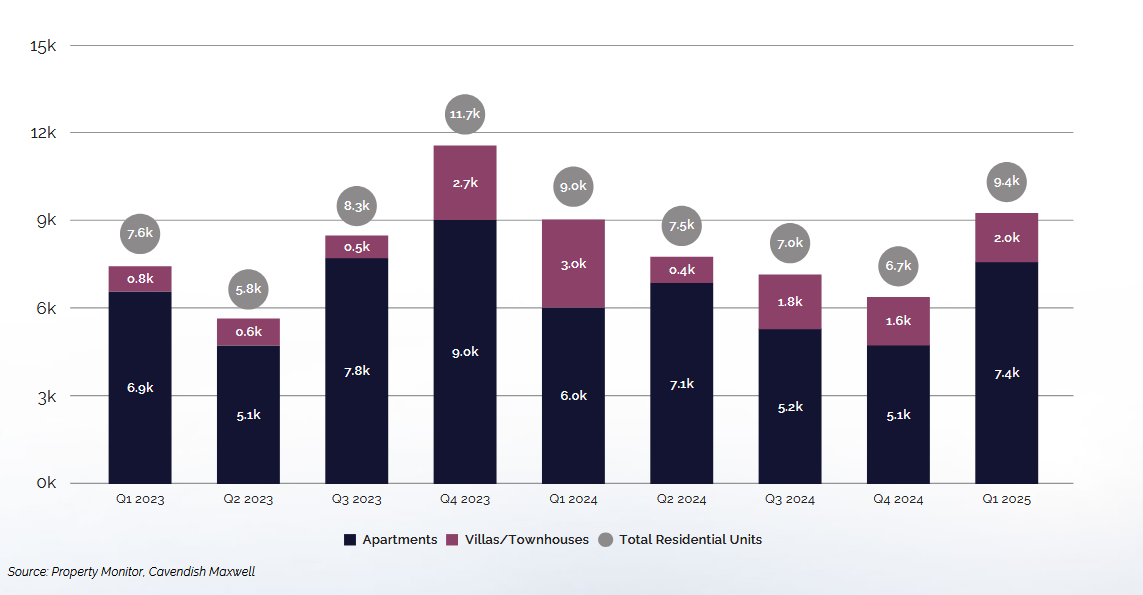
In the first quarter of 2025, Dubai added approximately 9,300 new residential units to its housing stock — a strong start to the year and a clear sign of the city’s ongoing real estate momentum.
This level of delivery marks one of the highest quarterly volumes in recent memory. It reflects both the push by developers to complete ongoing projects and the growing appetite from end-users and investors alike.
Roughly eight out of ten units delivered were apartments, with the rest being villas and townhouses. This distribution aligns with Dubai’s urban development pattern, where vertical living continues to dominate key districts.
Hotspots of Activity
Several neighborhoods stood out as major contributors to the new supply. Jumeirah Village Circle led the way with over 2,400 units handed over — continuing its transformation into one of Dubai’s most active mid-market communities. Mohammed Bin Rashid City, Business Bay, Downtown Jebel Ali, and Rukan also saw notable handovers, each adding hundreds of units to their growing landscapes.
- Jumeirah Village Circle (JVC): around 2,433 units
- Mohammed Bin Rashid City (MBR City): about 1,037 units
- Business Bay: approximately 743 units
- Downtown Jebel Ali: around 647 units
- Rukan: about 636 units
These areas have been magnets for both new residents and investors, thanks to competitive pricing, strategic locations, and an increasing number of amenities and infrastructure upgrades.
Impact on the Market
Although Q1 marked a 10% quarter‑on‑quarter slowdown in sales transaction volume (dropping to 42,200 transactions), year‑on‑year growth remained strong: transactions rose 23%, with total sales value climbing to AED 114.4 billion — up nearly 30% vs. Q1 2024.
Price metrics also showed firm growth:
- Sales prices rose 2.8% Q‑on‑Q and 15.8% Y‑on‑Y
- Rental prices increased 1.0% Q‑on‑Q and 14.4% Y‑on‑Y
- Gross rental yields stood at 7.3% for apartments and 5.0% for villas/townhouses
The influx of fresh supply—9,300 units in just one quarter—is a key factor behind the modest rental growth pace, and signals a market balancing toward greater supply-demand equilibrium
Looking Ahead: Pipeline & Projections
For the rest of 2025, Cavendish Maxwell estimates an additional 73,000 units expected to complete, with nearly 300,000 new units scheduled by 2028. However, only 21% of these projects have reached 75% or more construction progress—suggesting potential delays ahead.
- Supply surge in Q1 suggests developers pushing to hand over backlog inventory, especially in high‑demand areas like JVC and MBR City.
- Slower quarterly rent growth reflects tenant negotiating power amid rising availability—especially since renewal contracts rose to around 70% of leases, boosted by the new Smart Rental Index.
- Steady investor demand — despite softer Q1 volume — reinforced by attractive yields and macroeconomic optimism.
In short: Q1 2025 marked a powerful delivery phase for Dubai’s residential market—with nearly 9,300 units handed over—and reinforced the city’s trajectory toward moderate price growth and stabilized rental trends. Even as supply surges, demand momentum and investor confidence remain strong, underpinned by Dubai’s evolving economic fundamentals.