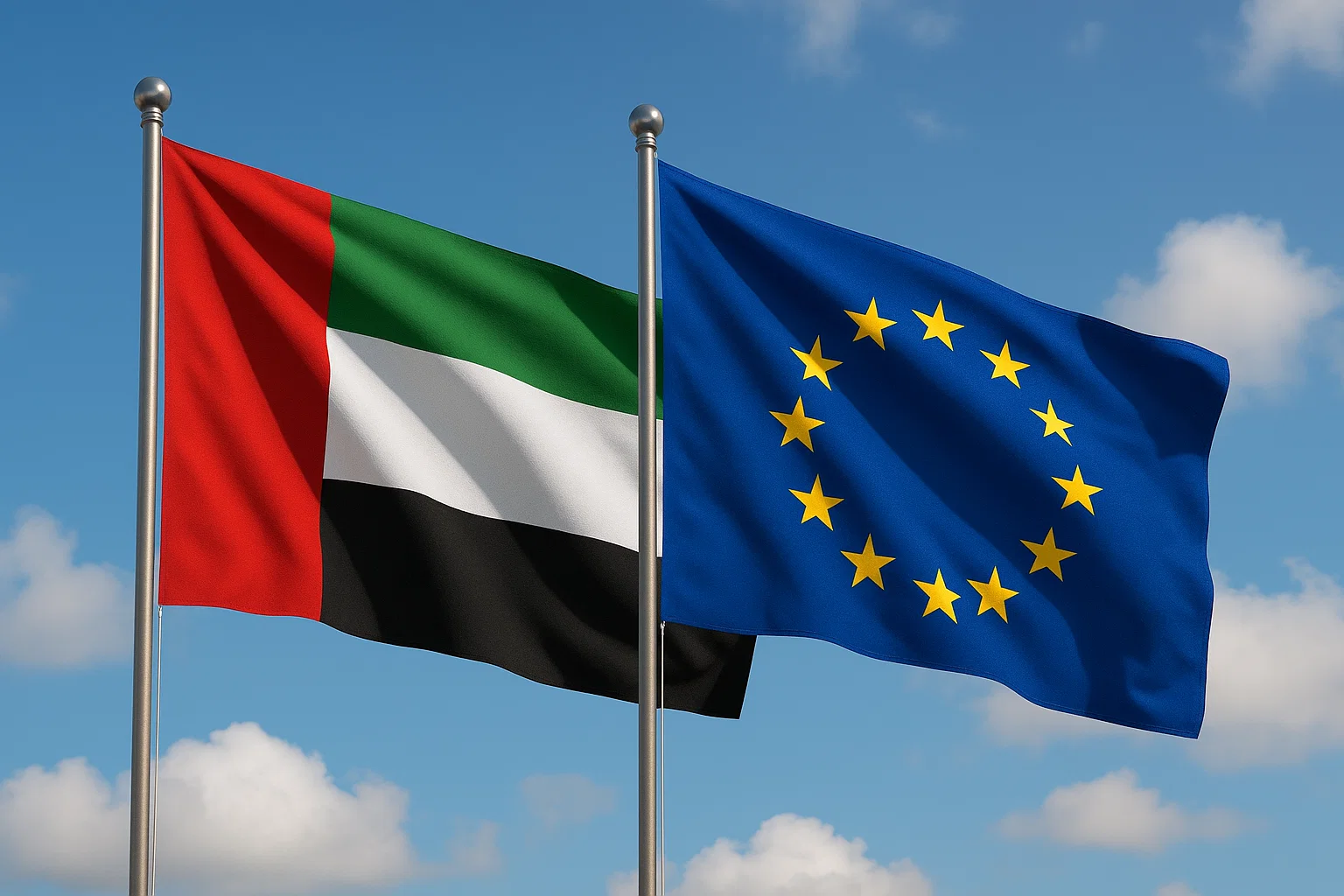
The United Arab Emirates and the European Union have officially launched negotiations on a Strategic Partnership Agreement, marking a significant development that reflects the depth of economic and political relations between the two sides and signals a new phase of advanced cooperation. The start of negotiations was announced by Dubravka Šuica, European Commissioner for the Mediterranean and responsible for relations with the Gulf states, together with Lana Nusseibeh, UAE Minister of State, underscoring the shared political will to reach an ambitious and balanced agreement.
A Comprehensive Trade Framework with Broad Horizons
The agreement aims to establish an integrated trade framework that reduces barriers to trade and investment between the two parties, while keeping pace with global shifts toward the digital economy and sustainability. Its key pillars include:
- Reducing or eliminating customs duties on industrial and agricultural goods, facilitating the export of Emirati products to the European market and vice versa.
- Facilitating the flow of services and investment, particularly in vital sectors such as financial services, telecommunications, and professional services.
- Enhancing digital trade and data protection, and supporting the digital economy and artificial intelligence.
- Strengthening cooperation in strategic sectors, including renewable energy, green hydrogen, critical raw materials, and the green and digital transitions.
Expected Scope of the Agreement
The agreement is expected to cover core areas similar to other EU free trade agreements, including:
- Trade in goods: Reducing or eliminating tariffs on most goods, with limited exceptions for sensitive sectors.
- Trade in services and investment: Improving market access conditions for companies from both sides and providing robust investment protection.
- Intellectual property: Protecting patents, trademarks, and copyrights, and ensuring effective enforcement mechanisms.
- Digital trade: Establishing rules for e-commerce, data flows, and consumer protection.
- Sustainability: Incorporating commitments related to the environment, climate, and labor standards, as part of the Sustainable Impact Assessment (SIA) prepared by the European Union.
Strategic Importance for the UAE
If concluded, this agreement would be the first comprehensive free trade agreement between the European Union and a single Gulf country, giving the UAE a significant competitive advantage. The expected benefits for the UAE include:
- Increased Emirati exports to the European market, one of the largest markets in the world.
- Attracting new European investments in sectors such as technology, clean energy, and advanced services.
- Strengthening the UAE’s position as a logistics and trade hub linking East and West.
- Supporting economic transformation plans, such as “UAE 2031,” by diversifying the economy and deepening links with advanced markets.
A Bilateral Agreement with a Regional Vision
It is worth noting that the UAE is currently participating in broader negotiations between the European Union and the Gulf Cooperation Council (GCC) on a regional free trade agreement. However, the EU–UAE agreement is being negotiated separately as a bilateral deal. The European Union views this bilateral agreement with the UAE as a potential cornerstone for a wider regional agreement with the GCC in the future.
Negotiation Process and Outlook
The negotiations will continue over several rounds, during which both sides will discuss tariff schedules, rules of origin, conditions for services and investment, as well as intellectual property and sustainability issues. While no official deadline has been announced, both parties aim to reach an ambitious and balanced agreement that serves the economic interests of both sides.
In conclusion, this agreement represents a historic opportunity to deepen the partnership between the UAE and the European Union and to establish an advanced model of cooperation that combines trade openness, innovation, and sustainability—delivering long-term positive impacts on both economies.