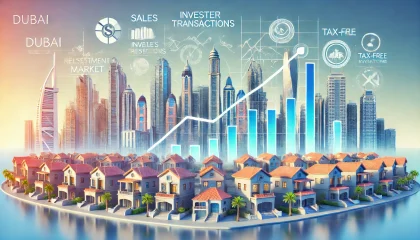
Dubai ended 2025 at an unprecedented historic level in terms of property sales value, with total sales reaching AED 682.49 billion, representing 30.64% growth compared to 2024. This was accompanied by an increase in the number of transactions to 214,912 deals, up 18.82% year on year. In parallel, the total value of real estate dispositions (sales + mortgages + gifts) rose to AED 919 billion (+20.8%), while the total number of dispositions reached 275,442 transactions (+21.81%).
These are not merely headline figures; they represent a composite indicator of real demand, liquidity depth, investor behavior, financing balance, and the structural evolution of the market.
Breaking Down the Growth: Volume or Price?
When sales value grows by 30.64% while transaction volume rises by 18.82%, this clearly indicates that growth was not driven solely by a higher number of transactions, but also by an increase in the average transaction value.
- Average sale value in 2025: ≈ AED 3.18 million
(AED 682.49bn ÷ 214.912k transactions) - Average sale value in 2024: ≈ AED 2.89 million
(AED 522.36bn ÷ 180.86k transactions)
This implies that the average investment ticket increased by roughly 10% within a single year.
Such a pattern typically reflects one or more of the following:
- An improvement in the product mix, with a higher share of large-ticket transactions (villas, luxury units, land, prime locations).
- Price appreciation in specific segments, particularly in high-demand areas.
- A shift by investors toward larger units or from mid-tier locations to stronger, more established districts.
Liquidity and Financing: What Does the Mortgage Ratio Say About Market Heat?
Mortgage transactions in 2025 totaled AED 179.26 billion across 50,974 deals. When compared to total sales value of AED 682.49 billion, mortgages represented approximately 26% of sales.
This ratio is a key indicator of the financing structure of the market. In markets heavily dependent on credit, cyclical risks increase, as any change in interest rates or lending conditions quickly translates into a sharp slowdown in demand—typical boom-and-bust behavior.
By contrast, a mortgage ratio around one quarter of total sales, as seen in 2025, points to a balanced market driven by a combination of:
- Cash and equity-heavy purchases, and
- Controlled, non-excessive bank financing.
This balance provides the market with greater resilience to interest-rate fluctuations and reduces sensitivity to credit shocks.
Important: This does not imply the absence of risk, but it does indicate that leverage is not the sole driver of growth.
Q4 2025: Why Was It Exceptional?
The fourth quarter of 2025 delivered AED 187.47 billion in sales—the highest quarterly figure ever recorded—driven by three exceptionally strong months:
- October: AED 58.43bn
- November: AED 64.22bn
- December: AED 64.82bn (+51.98% YoY)
From an analytical perspective, this performance can be explained by several overlapping factors. Chief among them is the pull-forward effect, whereby investors accelerate purchasing decisions when expectations of further price increases, supply changes, or major project launches prevail, prompting them to close deals before year-end.
Additionally, the final quarter typically sees a concentration of project launches and payment-plan incentives, as developers intensify marketing campaigns, introduce more attractive financing terms, and convert initial reservations into registered sales—significantly boosting transaction volumes.
A psychological-financial factor also plays a role: closing the year with record-breaking figures creates a positive market narrative, reinforcing confidence, increasing liquidity inflows, and attracting additional capital over a short period.
Why the AED 919bn in Total Dispositions Matters More Than Sales Alone
The rise in total real estate dispositions to approximately AED 919 billion in 2025 reflects the true scale of real estate economic activity in Dubai. This figure extends beyond sales to include mortgages and gifts, offering a more comprehensive view of market dynamics and financial depth.
This indicates that market growth is not limited to traditional buying and selling, but also encompasses:
- Refinancing and mortgage activity as tools for liquidity management and capital efficiency.
- Ownership transfers via gifts, underscoring real estate’s role in wealth structuring.
In this context, property is increasingly used as a multifunctional financial asset—not only for housing or direct investment, but also as collateral and a vehicle for wealth preservation and growth.
This trend aligns with Dubai’s long-term strategic vision, which targets approximately AED 1 trillion in real estate transactions by 2033 as part of the sector’s development strategy, positioning real estate as a core pillar of the economy and reinforcing Dubai’s status as a leading global property market.
Top Areas: What Do They Reveal About Demand Structure?
In 2025, Business Bay led the market with sales of approximately AED 38.31 billion, followed by Jumeirah Village Circle (JVC) at AED 24.52 billion, Al Yelayiss 1 at AED 23.75 billion, Dubai Investment Park Second at AED 23.16 billion, and Palm Jumeirah at around AED 21.4 billion, alongside other high-activity areas.
Analytically, the presence of Business Bay, Burj Khalifa, and Downtown Dubai among the top-performing areas reflects sustained demand for core, central locations characterized by proximity to business hubs, advanced infrastructure, and high liquidity—key attributes for investors seeking stability and exit flexibility.
Meanwhile, the strong showing of JVC and areas such as Al Yelayiss and Dubai Investment Park Second confirms that growth is not confined to the luxury segment alone. Instead, it extends deeply into the mid-market and upper mid-market, enhancing overall market balance and reducing reliance on a single segment.
The inclusion of Palm Jumeirah and Palm Jebel Ali further highlights the strength of investments driven by scarcity, branding, and lifestyle premiums, attracting investors focused on exclusivity and long-term value rather than short-term supply cycles.
Why Did Dubai Grow So Strongly?
Rather than relying on a simplistic explanation of “strong demand and supportive policies,” a more professional analysis identifies four interconnected drivers:
- Demographics and Real Demand: Population growth, workforce expansion, and a shift from renting to owning among residents have generated sustained, genuine demand, alongside a rise in resident investors viewing property as a long-term asset.
- International Capital Flows: Dubai has become a destination for global capital allocation, with international investors balancing portfolios through assets offering higher rental yields, lower tax exposure, and strong market liquidity.
- Evolution of the Property Product: Flexible payment plans, a wide range of off-plan projects, and improved design quality, amenities, and services have increased price acceptance and broadened demand across investor and end-user segments.
- Regulatory Framework and Market Infrastructure: Clear regulations, enhanced transparency, and access to official data and digital services have strengthened confidence, reduced mispricing risks, and reinforced a mature investment environment.
Market Health Indicators vs. Cyclical Risks
Market data from 2025 reveals several positive health indicators. The simultaneous growth in transaction volume and value points to genuine liquidity depth rather than isolated large deals. Mortgages did not dominate sales, indicating reliance on real liquidity rather than excessive credit expansion. Geographic diversification between prime and mid-market areas further reduced sensitivity to any single segment.
However, certain factors warrant monitoring in 2026:
- Upcoming supply pipeline, particularly in mid-market apartments, which could pressure prices or increase rental competition in specific areas.
- Speculative behavior in some off-plan projects, where high resale activity may require closer oversight.
- Global interest rates and financing conditions, as sudden tightening could slow momentum in finance-sensitive segments.
Key takeaway: The market is strong, but strength does not eliminate localized or segment-specific cycles.
What Does This Mean for Investors and Decision-Makers?
The results of 2025 confirm that Dubai is no longer a short-cycle, seasonal market. It has evolved into a long-term growth market supported by real demand, capital inflows, regulatory strength, and product development.
In 2026, the advantage will lie with investors who make selective, data-driven decisions—focusing on areas with genuine residential and employment demand and strong transport connectivity, avoiding late entry into overheated projects lacking rental fundamentals, and carefully analyzing upcoming supply at the micro-area level (micro-supply analysis).
For brokers and real estate marketers, the numbers provide powerful narrative material, but professional execution requires translating them into:
- Comparisons of average deal values and liquidity depth
- Clear differentiation between high-liquidity areas and speculative zones
- Content anchored in official data with monthly and quarterly updates
Conclusion
Dubai recorded a dual surge in 2025: a clear increase in transaction volume alongside an even stronger rise in sales value. This confirms that growth was driven by both broader demand and higher average deal sizes, not by a single factor. Q4 marked the peak, and the map of top-performing areas shows that growth was deep and well-distributed across prime and mid-market segments, reflecting a healthy balance and reinforcing the narrative of market maturity and sustainable momentum.