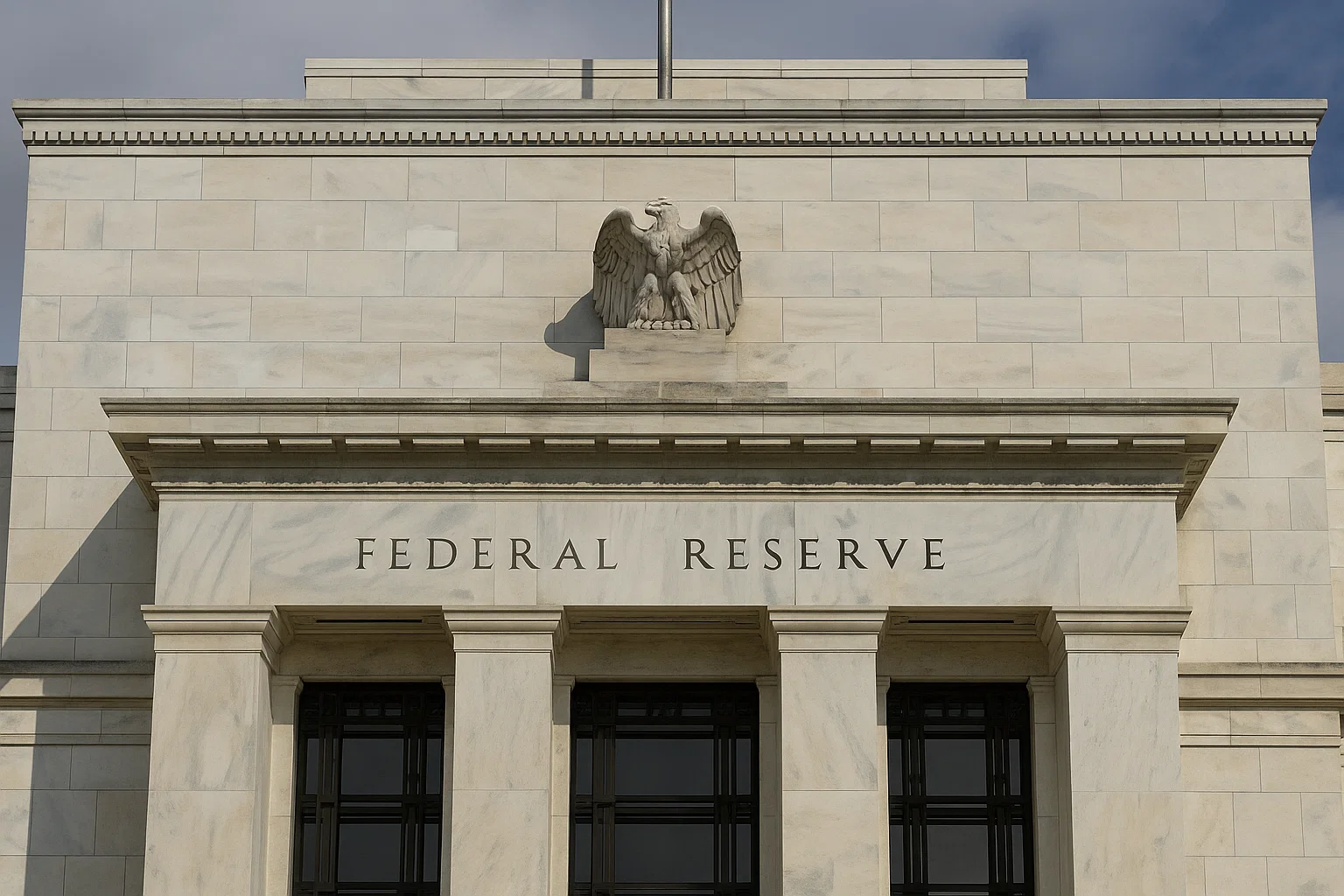
The U.S. Federal Reserve announced a 25 basis point (0.25%) rate cut, bringing the federal funds rate to a range of 4.00% – 4.25%, in line with market expectations. This marks the first reduction in borrowing costs since last December, aimed at supporting the economy amid inflationary pressures and slowing global growth.
Although the decision was broadly backed within the Federal Open Market Committee, newly appointed Governor Stephen Miran dissented, preferring a larger half-point (0.50%) cut, reflecting a more aggressive stance toward supporting growth.
Updated Economic Projections
Alongside the rate decision, the Fed released revised economic forecasts:
- GDP Growth:
- 2025: Raised to 1.6% from 1.4%.
- 2026: Raised to 1.8% from 1.6%.
- 2027: Raised to 1.9% from 1.8%.
- Inflation (PCE):
- 2025: Unchanged at 3%, as in June’s projection.
- 2026: Revised higher to 2.6% from 2.4%.
- Core PCE: Left at 3.1% for 2025, but revised up for 2026 to 2.6% from 2.4%.
- Unemployment:
- 2025: Unchanged at 4.5%.
- 2026: Revised slightly lower to 4.4% from 4.5%.
What the Decision Means for Markets
The rate cut signals the start of a new cycle of monetary easing, aimed at striking a balance between supporting growth and keeping inflation in check. Markets had already priced in the move, so the immediate reaction was relatively muted. However, the Fed’s indication of further cuts—another 50bps by the end of 2025 and 25bps in 2026—reassures investors that the central bank remains committed to gradually reducing economic pressures.
This development is expected to lower borrowing costs for businesses and consumers, potentially boosting appetite for riskier assets such as equities and real estate, while bond yields will likely remain under pressure as interest rate expectations decline.
Conclusion
The Fed’s rate cut was widely anticipated, but the key takeaway lies in its forward guidance. Upgraded growth forecasts combined with persistent inflation pressures highlight the delicate path the central bank must navigate—stimulating economic activity while safeguarding price stability.
Source: Federal Reserve