The UAE’s real estate sector remains one of the most prominent drivers of investment in the region and the world, consistently recording record-breaking levels in both the number and value of transactions. This exceptional performance reflects the attractiveness of the UAE market to both local and international investors, supported by a stable economic environment and investor-friendly regulations.
Dubai: The Global Powerhouse
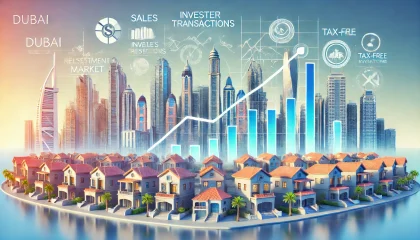
Dubai continues to lead the scene thanks to its position as a global city for real estate investment. In recent months, the emirate has witnessed a significant increase in sales volume, driven by strong demand from foreign investors, particularly from Europe and Asia.
High-end projects such as seafront villas and panoramic apartments in Downtown Dubai and Palm Jumeirah remain highly sought after. Investment returns in Dubai are among the highest globally, ranging between 6% and 8% annually in some areas, making it more attractive compared to major cities like London or New York.
This performance further strengthens Dubai’s image as a global hub capable of combining luxurious living with investment value.
Abu Dhabi: Stability and Steady Growth
In the capital, Abu Dhabi, the focus is on medium- and long-term projects, supported by strong government backing that ensures sustainable growth.
Areas such as Saadiyat Island and Yas Island are witnessing increasing demand from investors and residents seeking a high quality of life and integrated facilities. The government has introduced major incentives, such as foreign freehold ownership in specific areas, which has boosted international investor confidence and opened the door to new capital inflows.
Thus, Abu Dhabi represents the ideal destination for those seeking long-term stability alongside added value in both living and investment.
Ras Al Khaimah: The Rising Star
Meanwhile, Ras Al Khaimah is gradually transforming into a new star on the UAE’s real estate map.
Large-scale projects such as luxury resorts and beachfront villas, particularly in Al Hamra and Al Marjan Island, attract investors looking for more competitive prices compared to Dubai and Abu Dhabi.
The announcement of international projects like the Wynn Resort has attracted strong interest from global investors, cementing the emirate’s reputation as a promising tourism and investment hub. This growth makes the emirate an attractive choice for investors looking for new opportunities at an early stage.
Shared Drivers of the Market
The UAE has positioned itself at the forefront globally through flexible, forward-looking regulations.
Regulations
- The introduction of foreign freehold ownership in key areas has given investors greater long-term confidence.
- 10-year Golden Visas have encouraged entrepreneurs and high-net-worth individuals to relocate with their families.
- Property rights protection through advanced registration systems ensures transparency in transactions, reducing risks for foreign investors.
Foreign Demand
- Capital inflows from Europe, Russia, India, and China are not just short-term trends but a strategic shift driven by the search for safe and stable markets.
- Geopolitical events, such as the Russia-Ukraine war and economic slowdowns in parts of Europe, have reinforced Dubai and Abu Dhabi as alternative safe havens.
- Asian investors, particularly from China and India, view the UAE as a strategic gateway to the Middle East and Africa.
Infrastructure
The UAE is not just building towers, but developing fully integrated cities that combine transport, technology, and industry.
- Transport & Logistics: Expansions at Dubai International Airport and Abu Dhabi’s new terminal, world-class ports (Jebel Ali, Khalifa), and highways enhance connectivity, cementing the UAE as a global logistics hub. Future transport projects such as the Abu Dhabi Metro and Dubai Metro expansions will further boost surrounding residential and investment areas.
- Technology & AI: The UAE has a clear digital transformation and AI strategy under the UAE National AI Strategy 2031, which enhances real estate through smart city management, property data analytics, efficient government services, and intelligent community systems.
- Industry & Diversification: Beyond real estate and tourism, the UAE is building a robust industrial base through initiatives like “Operation 300bn”, aimed at increasing industry’s contribution to GDP. This supports job creation and drives demand for both residential and commercial property.
The UAE’s infrastructure has evolved into an integrated ecosystem of smart transport, digital economy, and advanced industry, reinforcing its attractiveness as one of the most sustainable and growth-ready markets in the world.
Economic and Political Stability
The UAE is ranked among the most stable countries in the region—a cornerstone for attracting both foreign and domestic investment. Investors seek safe, low-risk environments, and the UAE delivers exactly that.
In parallel, the country pursues smart economic policies, including:
- Diversifying income sources beyond oil, with growth in tourism, technology, industry, and financial services.
- Attracting foreign direct investment through flexible ownership laws, streamlined registration procedures, and competitive tax incentives.
- Launching long-term strategies such as the UAE Digital Economy Strategy 2031, Operation 300bn, and the National AI Strategy, which give investors clarity and confidence about the market’s future.
High Investment Returns (ROI)
Rental yields in the UAE are among the highest in the world, ranging between 6% and 8% annually across many projects. By contrast, major cities like London offer returns of around 3%, while Hong Kong stands at just 2.5%.
This significant gap makes the UAE a far more profitable and efficient market, allowing investors to recoup their capital more quickly than in traditional global hubs. Combined with stability and progressive legislation, the UAE remains a top choice for global capital seeking both safety and high returns.
Tourism as a Real Estate Driver
Tourism in Dubai, Abu Dhabi, and Ras Al Khaimah plays a pivotal role in fueling demand for serviced apartments and short-term rentals, with visitors seeking flexible accommodation that balances comfort and prime locations.
Expo 2020 Dubai was a turning point, firmly placing the UAE on the global tourism map and significantly boosting visitor flows. Since then, the steady stream of events and exhibitions hosted across the country each month has had a direct positive impact on both real estate and other sectors.
Additionally, the 2022 FIFA World Cup in Qatar had a spillover effect on the UAE, with many fans and visitors opting to stay in Dubai, Abu Dhabi, and Ras Al Khaimah while traveling to Doha for matches. This drove demand in aviation, hotels, and short-term rentals, highlighting the UAE’s position as a complementary tourism hub in the region.
Innovation in Real Estate Projects
Leading developers such as Emaar, Aldar, Nakheel, and Omniyat have increasingly focused on smart and sustainable projects, raising the long-term value of the market.
Innovations include green buildings, reliance on renewable energy, and the creation of integrated smart communities equipped with cutting-edge technology. These elements enhance the UAE’s future market appeal, aligning with global investor demand for modern, sustainable environments.
With its three real estate hubs—Dubai, Abu Dhabi, and Ras Al Khaimah—the UAE has firmly established itself as a global investment powerhouse. By offering a unique blend of luxury in Dubai, stability in Abu Dhabi, and emerging opportunities in Ras Al Khaimah, the country not only demonstrates the strength of its property market but also positions itself to continue expanding and thriving—even amid global economic volatility.