Key Takeaways
- Despite the noticeable decline in passenger numbers at Dubai International Airport during the first quarter of 2026, a deeper look at the data reveals a more balanced picture that reflects the resilience of Dubai’s aviation sector and its ability to adapt to regional challenges.
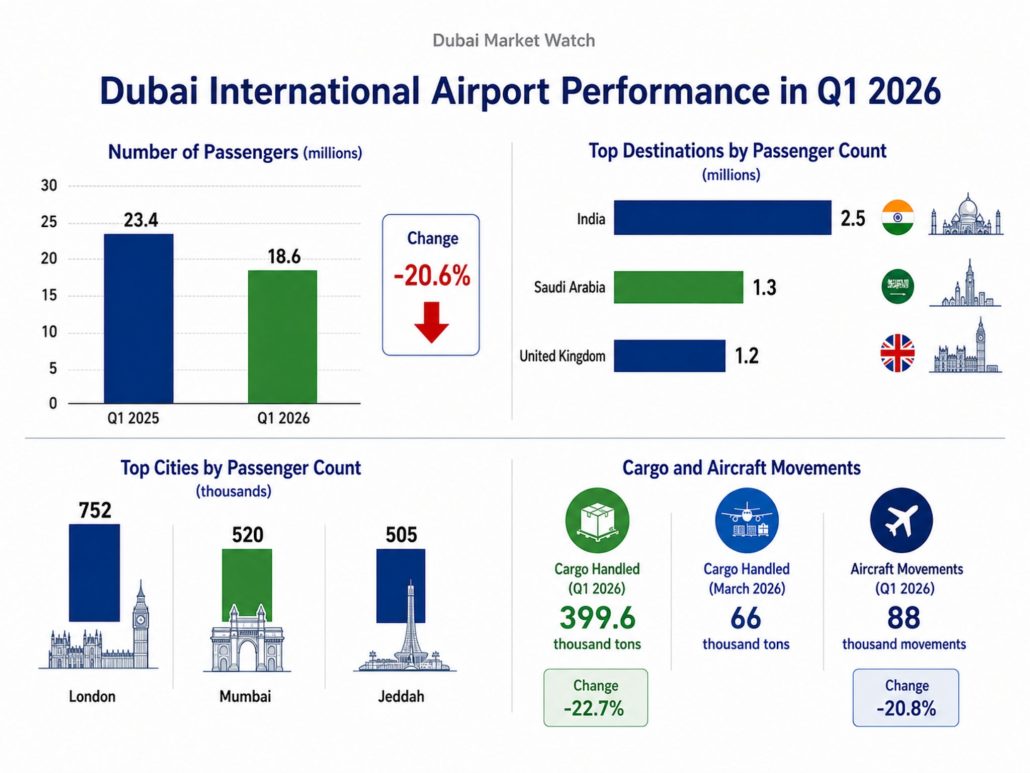
- The airport recorded around 18.6 million passengers in the first quarter, a decrease of 20.6% compared to the same period last year.
- Despite these conditions, Dubai Airports handled more than 6 million passengers from the end of February through the escalation of events in March.
Despite the noticeable decline in passenger numbers at Dubai International Airport during the first quarter of 2026, a deeper look at the data reveals a more balanced picture that reflects the resilience of Dubai’s aviation sector and its ability to adapt to regional challenges.
The airport recorded around 18.6 million passengers in the first quarter, a decrease of 20.6% compared to the same period last year. This drop is directly linked to regional tensions, which led to airspace restrictions and the disruption of some flights — factors that are beyond the normal operational scope of any global airport.
Despite these conditions, Dubai Airports handled more than 6 million passengers from the end of February through the escalation of events in March. During this period, around 32,000 flight movements were recorded, along with the handling of over 213,000 tons of cargo, reflecting strong operational efficiency and continuity of services even under challenging circumstances.
One notable point in the data is the continued strength of demand from key markets. India remained the top destination with around 2.5 million passengers, followed by Saudi Arabia with 1.3 million passengers, and the United Kingdom with approximately 1.2 million passengers. This highlights the strong economic and tourism ties between Dubai and these major markets.
Major cities also continued to lead, with London ranking first as the top city destination with 752,000 passengers, followed by Mumbai with 520,000 passengers, and Jeddah with 505,000 passengers. This reinforces Dubai’s position as a global hub connecting East and West.
On the cargo side, total volumes handled during the first quarter reached approximately 399,600 tons, with 66,000 tons recorded in March alone. Despite the decline due to operational conditions, these figures confirm Dubai’s importance as a key logistics hub in the region.
Aircraft movements reached around 88,000 during the first quarter, a level that reflects continued operational activity despite the challenges, and highlights the readiness of infrastructure to accommodate future growth once full stability returns.
Overall, the performance of Dubai International Airport during this period shows that the decline was temporary and driven by external factors, while the underlying economic and operational fundamentals remain strong. This supports expectations for a quick recovery and renewed growth momentum in the coming periods, especially given Dubai’s global position as a major hub for aviation, travel, and business.